
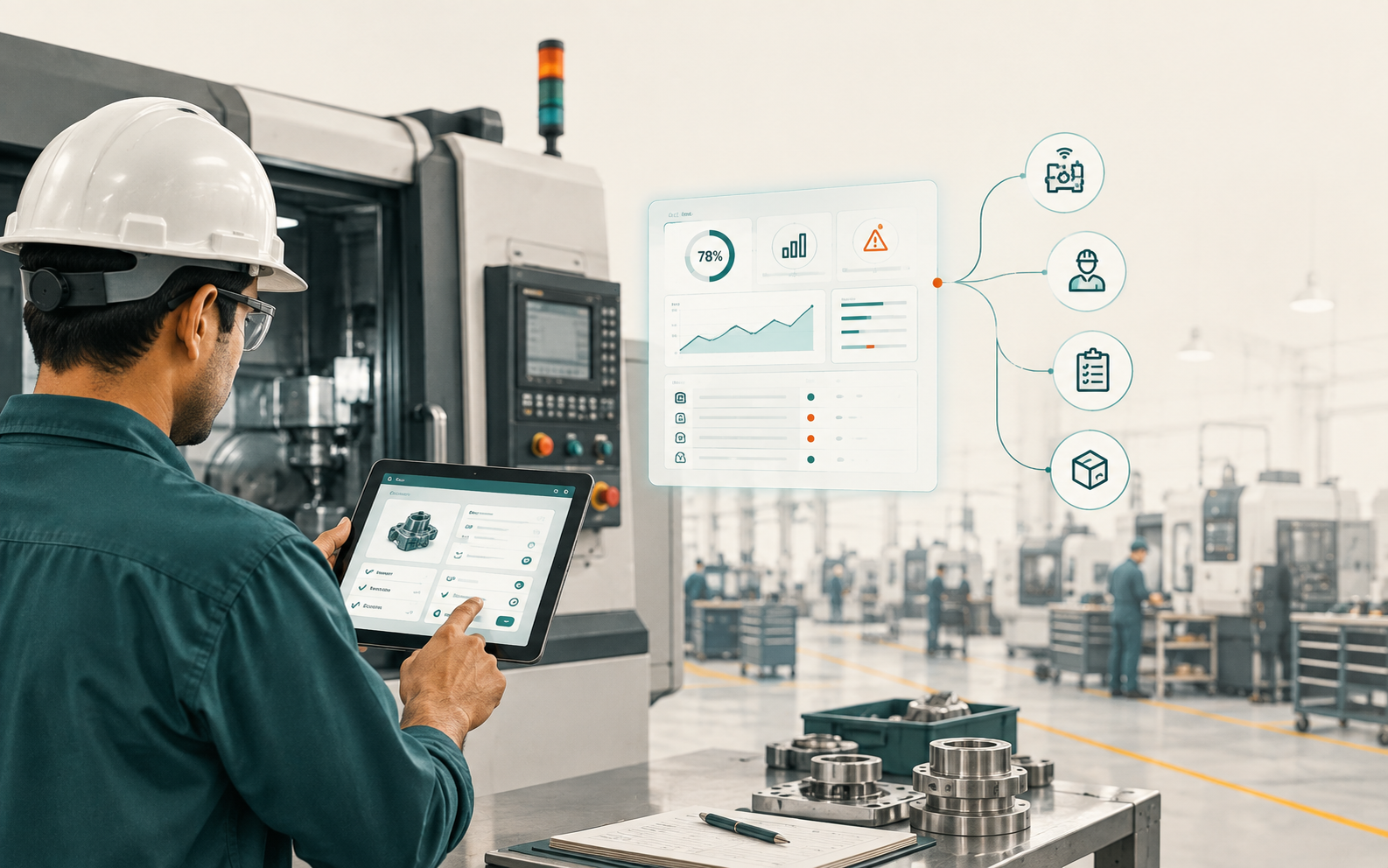
Shop floor digitization means your machines, operators and quality checks report what they are doing while they are doing it. The record stops being a sheet someone fills at the end of a shift. It becomes data that arrives at the moment the event happens.
That shift is now the main competitive line in manufacturing. In Deloitte's 2025 Smart Manufacturing and Operations Survey, 92% of manufacturers said smart manufacturing will be the main driver of competitiveness over the next three years, with respondents reporting 10% to 20% improvement in production output and 7% to 20% in employee productivity.
Before reading further, sit with three questions:
- If a customer calls today about a part you dispatched three weeks ago, how long before you can name the machine, the operator and the material batch that made it?
- Can you tell your MD what actually happened on shift 2 before the next morning's meeting, or only after the log sheets are collected and typed?
- When the IATF surveillance audit lands, is your inspection record standing proof, or a file someone rebuilds the night before?
If any of those took more than a second to answer, the gap is not your team. It is that the plant's memory lives on paper, and paper only speaks after someone walks it to a desk. This piece explains what shop floor digitization actually is, the four parts it is built from, where these projects fail in Indian MSME plants, and a ten minute test you can run today to see exactly which stage you are at.
TL;DR
- Shop floor digitization is a data collection problem first and a software problem second, so start with the record that gets demanded under pressure, not the record that is easiest to convert.
- The four parts are automated data collection, digital work instructions, live dashboards and integration with the systems you already run.
- Most failed projects in MSME plants die at operator adoption, not at technology.
- Your ERP or Tally knows what you billed. It does not know what the machine did. That gap is the whole subject.
- A plant that can trace a disputed batch in minutes defends its credibility with the customer, not just its paperwork with the auditor.
- Run the Shift-2 Test below before you speak to any vendor, including us.
What Is Shop Floor Digitization?
Shop floor digitization is the replacement of manual, paper-based production records with connected digital workflows, live data collection and software your team reads on a screen. It covers what the machine produced, why it stopped, who inspected the output and where that batch went.
The word that matters is connected. Scanning a log sheet into a PDF is not digitization, because the number still cannot be counted, compared or alerted on. Digitization means the reading enters the system as data at the point it is created, on the floor, by the person or machine that created it.
Here is what changes in practice:
|
Question the floor gets asked |
Paper and Excel plant |
Digitized plant |
|
What did Line 3 produce on shift 2? |
Known next morning, after sheets are collected and typed |
Visible on screen while the shift is still running |
|
Which material batch went into this dispatched part? |
Traced by hand across three registers |
Traced by scanning the part or batch number |
|
Why did the machine stop for 40 minutes? |
Written as "breakdown", cause unrecorded |
Logged against a reason code by the operator at the machine |
|
Was this batch inspected, and by whom? |
A signature in a QA file cabinet |
An electronic approval linked to the dispatch document |
Read the right-hand column again. None of it requires a new machine. It requires the moment of recording to move from the end of the shift to the middle of the work. That single move is what the four components below are built to do.
The 4 Key Components of Shop Floor Digitization
Every working shop floor digitization setup is assembled from the same four parts. Plants differ in how far they take each one, not in which ones they need.
1. Automated Data Collection
Sensors and Industrial IoT devices connect machines directly to the network, so output counts, cycle times, machine health and running status arrive without anyone writing them down. On older machines common in Indian MSME plants, this is usually done with a retrofit counter or a signal tap rather than replacing the control.
The layer most articles skip: not every reading should be automated. Rejection cause and downtime reason still need a human, because a sensor knows the machine stopped, not that the tool chipped.
2. Digital Work Instructions
These replace paper drawings, laminated SOPs and PDF manuals with a screen at the station that walks the operator through the step in front of them. The instruction updates centrally, so a revision reaches every station the same day instead of living as an outdated copy on one machine.
For plants running mixed-model lines, this is where changeover errors drop, because the screen changes when the job changes.
3. Real-Time Dashboards
Dashboards show live production against plan, machine status, rejection counts and quality alerts on one view. The plant head stops asking for a status and starts reading one.
The useful version is not a wall TV with a rolling chart. It is a screen where a red cell is a question someone must answer before the shift ends.
Is your quality data ready for an audit or scattered across notebooks?
Tell us what your plant records look like today. We'll show you what the digital version looks like mapped to your process, not a template.
4. System Integration
Integration connects floor data to the business systems above it, usually ERP, Tally or a costing sheet. Without it, production data and commercial data stay in two truths, and month-end becomes a reconciliation exercise.
We build this link both ways, so a dispatch document can pull the inspection record that belongs to it instead of a person hunting for the file. Our production management and traceability work almost always begins at exactly this join.
Four components, one purpose: make the plant's record arrive by itself. What that actually buys you is the next section.
What Shop Floor Digitization Changes on the Floor
The benefits are widely listed and rarely explained. Below, each one is paired with the mechanism that produces it, because a benefit without a mechanism is just a claim.
Reduced downtime. Live machine status plus reason-coded stoppages means the same fault stops being logged as "breakdown" forever. Once causes are separated, the top three repeat offenders become visible, and preventive maintenance can be scheduled against real running hours instead of a calendar.
Data-driven decisions. Managers read live plan against actual instead of yesterday's summary. The decision that changes is the small one: moving a job at 2 PM rather than discovering at 9 AM that it slipped.
Hours returned from manual entry. Every reading typed twice is a reading that can disagree with itself. Removing double entry gives supervisors back the end-of-shift hour and removes the transcription errors that quietly corrupt monthly output numbers.
A defence when a customer disputes a batch. This one no competitor lists, and it is the one MDs care about. When the trace exists, a complaint is answered with evidence in minutes.
|
"Competitiveness today is no longer defined by efficiency alone, but by the ability to sense, adapt and respond at speed." Kiva Allgood, Managing Director and Head of the Centre for Advanced Manufacturing and Supply Chains, World Economic Forum The 2025 Global Lighthouse cohort recorded, on average, a 40% labour productivity increase and a 48% reduction in lead time, with AI use cases delivering a 41% decrease in product defects. |

Gains like these are real, but they are also where most plants get their expectations set wrong. The next section is about what happens between the brochure and the shop floor.
Where Shop Floor Digitization Projects Actually Fail
We have walked into enough half-finished rollouts to say this plainly: the technology is rarely the reason. Here are the four failure patterns we see most often in Pune belt plants, and what each one costs.
The pattern under all four is the same. The plants that succeed change what they record first and buy software second. Which is why the honest first step costs nothing.
The Shift-2 Test: Score Your Readiness in 10 Minutes
Before you talk to any vendor, run this. Pick one part number your plant dispatched last month. Sitting at your desk, without calling the floor, try to answer the five questions below. Time yourself.
The five questions:
Score it:
|
Answer |
Score |
|
Answered from a screen in under 1 minute |
2 points |
|
Answered by calling one person |
1 point |
|
Answered by pulling a physical file, or not at all |
0 points |
Read your total out of 10:
|
Score |
Stage |
What this means |
|
0 to 2 |
Paper plant |
Your records exist but cannot be questioned. Start with traceability of dispatched parts, nothing else. |
|
3 to 5 |
Partially recorded |
Data is being written but not connected. Your fastest win is machine-side data collection on the two slowest lines. |
|
6 to 8 |
Visible plant |
You can see the floor. The gap is integration, so the shop data and the commercial data agree. |
|
9 to 10 |
Connected plant |
You are ready for the predictive layer, including maintenance scheduling on real running hours. |
Most MSME plants we assess score between 2 and 5, and almost all of them expected to score higher. That gap between assumed and actual visibility is the honest starting point for any production tracking or quality management work. Note your score. The rollout below is sequenced against it.
How to Digitize Your Shop Floor: A 5-Step Rollout for MSME Plants
Sequencing is what separates a rollout that survives from one that stalls at the pilot. The steps below are the order we follow on live plants, and they are deliberately narrow at the start.
The key steps involved are:


|
"The smart manufacturing journey is still emerging, but its value is undeniable. Most responding manufacturers agree with the need to invest in smart manufacturing but require help navigating operational complexities to see meaningful results." Tim Gaus, Smart Manufacturing Business Leader and Principal, Deloitte Consulting LLP In the same survey, 92% of manufacturers named smart manufacturing the main driver of competitiveness over the next three years, while only 29% had AI or machine learning running at facility or network scale. Source: Deloitte, 2025 |
Sequencing keeps the project alive. But for auto component suppliers there is one more force setting the deadline, and it does not wait for phase two.
Shop Floor Digitization and Your IATF 16949 Audit
For a Tier-1 or Tier-2 supplier, shop floor digitization is not only an operations decision. It is increasingly how you prove conformity, because the standard asks you to demonstrate control with retained records, not with recollection.
What an auditor is actually testing
An auditor rarely asks whether you have a system. They pick a part and ask you to walk it backwards: which process steps, which operator, which machine parameters, which material batch, and what the results were at each stage. A paper plant can usually do this. It just cannot do it quickly, and speed under questioning reads as control.
Is your quality data ready for an audit or scattered across notebooks?
Tell us what your plant records look like today. We'll show you what the digital version looks like mapped to your process, not a template.
Where paper records break under audit
Document control is one of the most common areas of non-conformity in these audits, and the usual causes are ordinary: an outdated revision still in use at one station, a missing signature, a record that cannot be produced within the session. None of these are quality failures. They are retrieval failures.
What changes when the record is digital
Approvals carry a user and a timestamp. The inspection record attaches itself to the dispatch document instead of sitting in a separate file. Revisions replace themselves at every station at once.
This is precisely the ground our traceability system work with an auto component manufacturer covers, and why our auto component clients tend to start here rather than with dashboards. There is one objection that comes up at this point in almost every conversation, so let us take it directly.
We Already Run Tally or an ERP. Why Isn't That Enough?
This is the most reasonable question an MD asks, and the answer is not that your ERP is bad. It is that an ERP and a shop floor system observe two different things.
|
Your ERP or Tally |
Shop floor digitization |
|
|
Records |
Transactions: orders, issues, receipts, invoices |
Events: cycles, stoppages, rejections, inspections |
|
Timing |
After the fact, when someone posts it |
As it happens, at the machine |
|
Answers |
What did we bill and what stock moved? |
What did the machine do and why? |
|
Blind spot |
The 40 minutes the machine was down |
Your commercial and financial position |
Your ERP knows a job was booked and closed. It does not know that the job took two extra hours because a tool broke at 3 AM on shift 2, because nobody told it. Shop floor digitization is the layer that tells it.
If you are weighing a packaged product against something built to your process, we have written that comparison separately in ERP vs custom software for manufacturers. For this article, the point is narrower: the two systems are not alternatives. One is the plant's ledger, the other is the plant's eyes.
Why Should You Choose Edhaas Digisoft for Shop Floor Digitization?
Your shop floor already has a working process. The problem is that the process only becomes visible after the shift ends. We build the system around that process instead of asking your operators to learn someone else's.
How we work:
- Custom systems shaped to your existing floor routine, never a template.
- Barcode and QR scanning with machine and IIoT data collection.
- Modular rollout sized for MSME budgets and timelines.
What plants report after go-live:
- Cycle time: 40% improvement in production cycle time after digital log sheets replaced manual tracking.
- Dispute handling: verified a disputed batch in minutes, confirming the items had been scrapped.
- Record integrity: zero missing records, with audit-ready documentation.
We are founder-led and hands-on, based in Pune and working across Chakan, Pimpri-Chinchwad and Ranjangaon, which means the person who mapped your process is the person who answers when something needs fixing after go-live. Our management dashboards and production dashboard case study show what this looks like in a running plant.
Ready to find out what your plant can actually answer? Schedule a Consultation
Conclusion
Shop floor digitization is not a technology purchase. It is a decision to move the moment of recording from the end of the shift to the middle of the work, so the plant's data arrives on its own and can be questioned while it still matters.
Run the Shift-2 Test this week and note your score honestly. Then fix the record that gets demanded under pressure first, connect it to the systems you already run, and widen only after one line proves it. Faster batch traces protect customer relationships, reason-coded downtime turns repeat faults into a fixable list, and audit-ready records stop consuming a week of management time every cycle.

Questions