Manufacturers rarely lose this decision on the software. They lose it on the sequence, buying a platform before naming the one process that is actually bleeding money. Gartner projects that more than 70% of recently implemented ERP initiatives will fail to fully meet their original business case goals by 2027, with as many as 25% failing outright.
Would your current system survive an OEM asking for a batch trace in under ten minutes?
Is your plant paying full ERP license fees for modules nobody on the shop floor opens?
If your next line runs a process no template was built for, what happens then?
Every plant head and MD weighing ERP against custom software is really asking one thing: will this fit how we actually make parts, or will we spend the next year bending our process to fit the software. This piece walks through both paths, and where they need to be combined.
TL;DR
The ERP vs custom software for manufacturers decision is not binary. Most plants that scale end up running both.
Start from the process losing you the most time or the most trust with an OEM, not from a platform shortlist.
IATF 16949's 6th edition rules make traceability gaps more visible at audit time, which changes how this decision should get made.
A custom layer around one painful process often costs less and moves faster than a full ERP rollout aimed at the same problem.
The real risk is not choosing the wrong system. It is choosing before you have named the process that needs fixing first.
What Is the Real Difference Between ERP and Custom Software for Manufacturers?
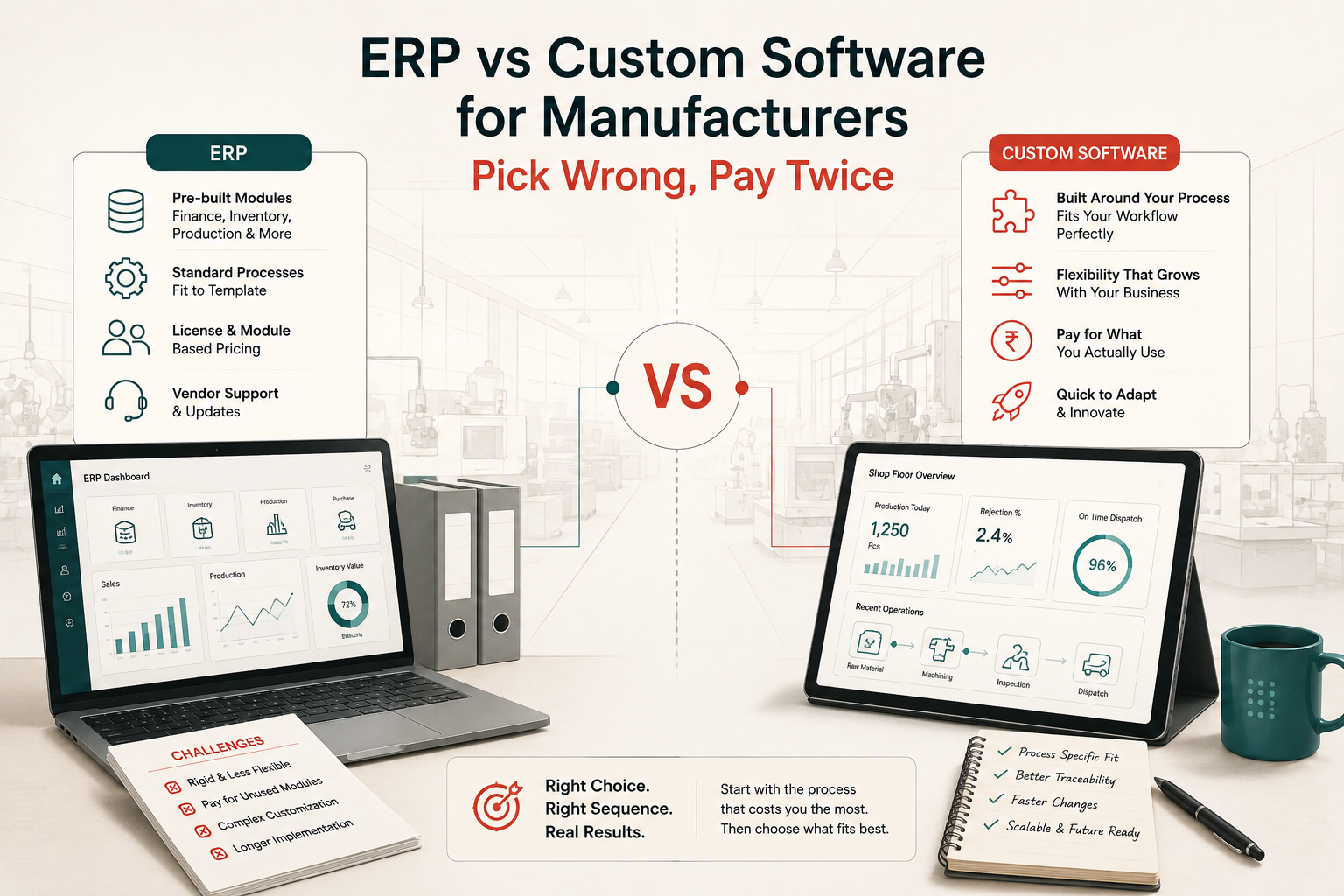
An ERP is a pre-built system that runs finance, inventory, procurement and production from one shared database. Vendors like SAP Business One, Oracle NetSuite and Odoo sell this as a standard package, built for how most manufacturers already operate.
Custom software is built around your specific plant, not a generic template. It fits the job cards, inspection formats and dispatch steps your team already uses, instead of asking your team to change how they work.
The difference shows up fastest on the shop floor, not in the sales deck. An ERP asks: does your process match ours. Custom software asks: what does your process actually need.
When a Commercial ERP System Makes Sense on Your Shop Floor
Commercial ERP fits certain plants better than others. Think of these as the conditions where it earns its cost.
-
Your processes already match industry norms. Standard batch production, standard BOM structures, nothing unusual to accommodate.
-
You need finance, inventory and production connected fast. A single database beats stitching five disconnected tools together.
-
Your internal IT bandwidth is thin. Vendor support and a large user community cover gaps a small team cannot.
-
You operate across multiple plants or entities. Centralized reporting matters more than any single plant's quirks.
This resulted in: predictable rollout timelines, vendor-backed support, and modules that already speak to common compliance formats. The tradeoff is rigidity. When your process is the exception, not the rule, an ERP starts working against you instead of for you.
Is your quality data ready for an audit or scattered across notebooks?
Tell us what your plant records look like today. We'll show you what the digital version looks like mapped to your process, not a template.
When Custom Software Is the Better Fit for a Manufacturing Plant
|
What you're solving for |
ERP fit |
Custom software fit |
|
A process unique to your plant (job-shop routing, a specific inspection format) |
Weak, needs heavy customization |
Strong, built around it directly |
|
Paying only for what the floor actually uses |
Weak, licensed by module and seat |
Strong, no unused-feature cost |
|
Fast trace on a disputed batch |
Depends on module depth |
Strong when built for that exact record trail |
|
Integrating an older CNC or PLC already on the floor |
Often needs a connector or middleware |
Strong, built to talk to what you already run |
|
Predictable, vendor-backed rollout timeline |
Strong |
Depends on the development partner |
Custom software wins wherever your process is the thing that makes you competitive, not a variation you're forced to accept. A forging shop's job card, a machining line's rejection workflow, a dispatch step tied to a specific OEM portal: these rarely map cleanly onto any template.

Nearly 70% of top economic performers use proprietary software to differentiate themselves from competitors, compared with just 50% of their peers.
Source: McKinsey & Company, industrial software research
That gap is not about company size. It is about which companies stopped forcing their floor to match someone else's software.
The Hybrid Approach: Why Most Growing Manufacturers Don't Pick Just One
Plants rarely stay on one side of this decision as they grow. A plant might run finance and procurement on a standard ERP, while production tracking and quality checks run on something built for that specific line.
The pattern repeats across growing manufacturers: use the ERP where the process is genuinely standard, and build custom where it isn't. Neither system has to carry weight it wasn't designed for. Our own note on production tracking on the shop floor goes deeper into what that looks like once tracking moves off paper.
This only works with clean integration between the two. A hybrid setup with no data bridge between systems creates two versions of the truth, which is worse than picking either system alone.
How to Decide: Start From the Process That's Already Costing You Money
Most comparisons hand you a checklist and ask you to pick a platform first. That order is backwards for a plant that is already losing hours somewhere specific.
The better sequence works like this:
-
Name the process bleeding the most time or trust right now. Late dispatch documents, a slow batch trace, a shift handover nobody can reconstruct.
-
Check whether a standard ERP module already covers it well. If yes, that's your answer, and the rest of the rollout follows the vendor's playbook.
-
If no module fits without heavy rework, price the custom build against the ERP customization quote. Compare the two on the same problem, not on features you don't need yet.
-
Decide the platform for everything else only after that first process is fixed. A working pilot on your worst pain point tells you more about fit than any demo does.

The pattern above is illustrative, not a quote for your plant. It reflects how ERP licensing tends to compound with users and modules, while a custom build's cost concentrates upfront and then flattens into maintenance.
This resulted in: plants that follow this order spend their first budget on the process actually hurting them, instead of on a platform-wide rollout that reaches that process eighteen months later.
What This Means for IATF 16949 Audits and OEM Contracts
The 6th edition of the IATF Rules took effect from January 2025 and changed how certification bodies plan and run audits, with sharper emphasis on digital traceability and supplier documentation (NSF). For a Pune-belt auto component supplier, that shift lands directly on what ever system holds your batch records.
A generic ERP module can log a batch number. It rarely reconstructs the full inspection-to-dispatch trail an auditor or an OEM quality team wants to see in one pull.
A custom traceability layer built around your actual inspection and dispatch steps can produce that trail in the format your auditor already expects, without a manual reassembly job. See how this looks in practice on our traceability solution page.
OEMs increasingly score suppliers on traceability maturity, not just price and quality, when awarding new contracts on new lines.
None of this makes ERP or custom software automatically wrong. It does mean the audit trail should be one of the first three processes you test in the sequence above, not an afterthought discovered two weeks before a surveillance audit.
Is your quality data ready for an audit or scattered across notebooks?
Tell us what your plant records look like today. We'll show you what the digital version looks like mapped to your process, not a template.
Why Should You Choose Edhaas Digisoft for This Decision?
Auto component suppliers rarely need a platform overhaul on day one. Most need the one process that's already causing disputes or delays fixed first, built around how the line already runs.
We build that first process as a working system before any larger platform conversation starts. Custom-built around your existing shop-floor steps, never a template forced onto your process. Barcode and QR capture that ties straight into machine and inspection data. Modular rollout scoped to what an MSME budget can actually absorb.
What this has looked like on real floors: Retrieval speed: seconds to trace a batch, instead of hours of paperwork. Dispute handling: a disputed batch verified in minutes, confirming which items were scrapped. Cycle time: a 40% improvement after moving one plant's log sheets off paper.
Your next OEM audit or contract decision does not wait for a full ERP rollout to finish. We map the process first, then build the piece that fixes it, with room to connect to a larger production management system later if your plant needs one.
Ready to find out which process should come first? Schedule a Consultation.
Conclusion
ERP and custom software both do their job well when they're matched to the right process, not chosen as a blanket bet on the whole plant at once. The sequence you choose them in decides whether the first year of spend fixes something real or sits half-used.
For auto component manufacturers, the process most worth fixing first is usually the one an OEM or auditor will ask about next. Start there, not with a platform shortlist.
Name the process actually costing you time or trust before comparing platforms.
Treat traceability and audit readiness as an early test, not a later add-on.
Expect to run both ERP and custom software as your plant grows, not just one.
Price a targeted custom fix against ERP customization for that same process before committing.

Questions