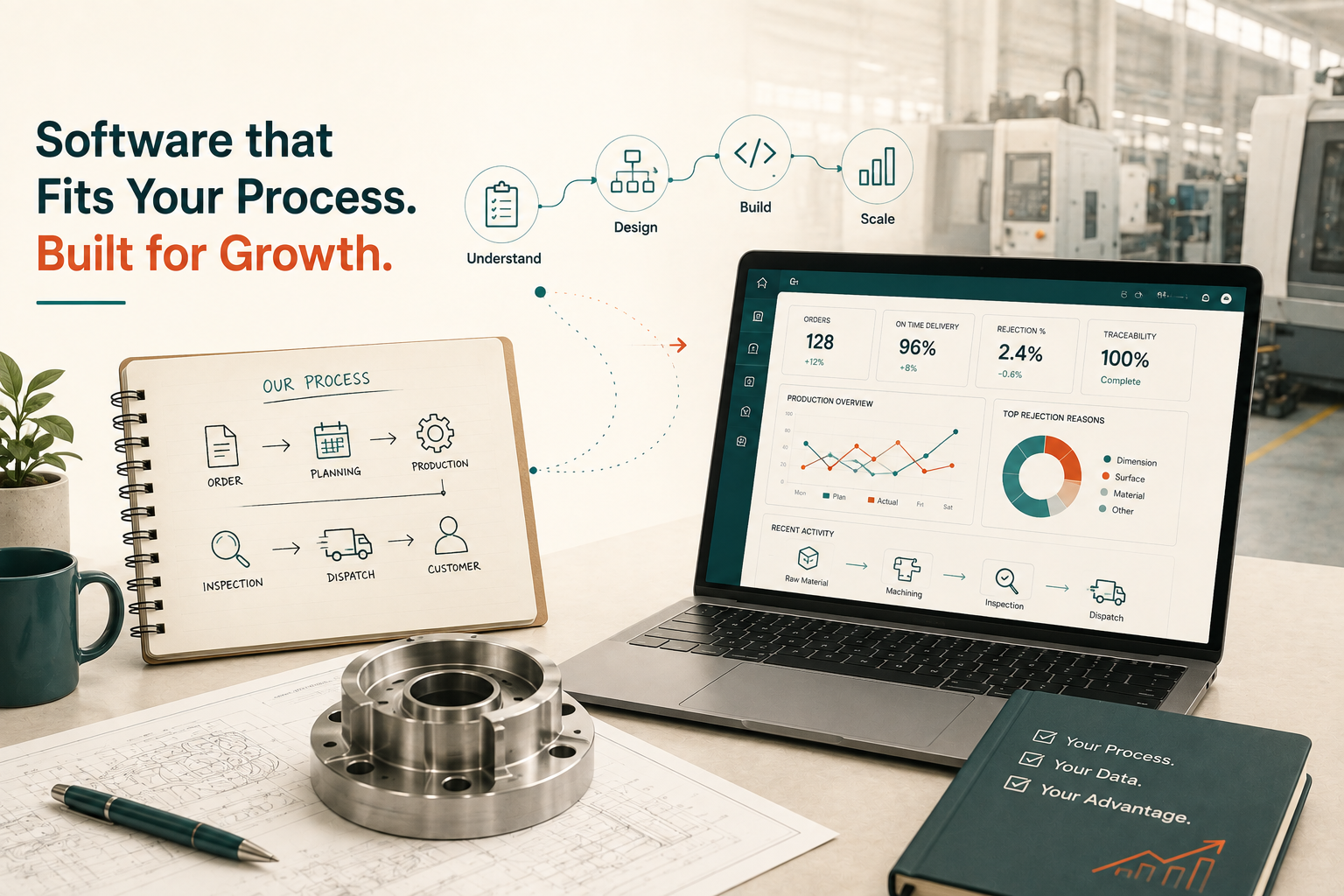
Customized software is an application built from scratch to match one organisation's actual workflow, instead of asking that organisation to bend its workflow to fit a packaged product. The distinction matters more in manufacturing than almost anywhere else. Two component plants making the same part rarely run the same process.
The money involved is not small. The global custom software development market is forecast to reach USD 146.18 billion by 2030, growing at 22.6% a year from 2025 . In India, the pressure is coming from the customer side. The auto component industry closed FY25 at Rs 6.73 lakh crore, up 9.6% year on year, after growing at a 14% CAGR since FY20 . Volumes have nearly doubled in five years. The record-keeping in most units has not changed at all.
Three questions worth sitting with before you read further:
- When an OEM asks for the full history of a specific batch, can you produce it the same day, or does someone have to go through files?
- How many Excel sheets and WhatsApp groups are still running your plant alongside the software you already pay a licence for?
- If your quality head resigned next month, how much of your process would leave the building with them?
Most plants in the Pune belt have already bought software. The problem is rarely that they have no system. It is that the system covers the parts of the business a vendor found easy to standardise, and leaves the parts that are actually yours to a supervisor with a spreadsheet.
TL;DR
- Off-the-shelf software fails quietly, not loudly. It gets bypassed rather than uninstalled.
- Count your shadow spreadsheets and WhatsApp groups. That number is your real fit gap.
- Custom builds give you the source code, so the process knowledge stays with your company.
- Project size predicts failure better than custom versus packaged does. Small and modular wins.
- The cost that hurts is not the licence. It is the hours your team spends re-entering data between systems.
- Scope one painful process first, prove it on one line, then extend.
What Is Customized Software?
Customized software is an application designed and built around a specific company's process, rather than sold as a finished product to many companies at once. It starts with how your plant already works. The software is then written to match that, not the reverse.
For a component manufacturer, this usually means the software speaks your language from day one. Your part numbers, your rejection codes, your shift pattern, your customer formats. Nothing has to be renamed to fit somebody else's data model.
Three things separate a custom build from a licensed package.
It fits your process instead of replacing it
A packaged product carries assumptions from whoever it was first built for. You adapt to those assumptions or you work around them. A custom build starts from your existing routing, inspection and dispatch steps and puts them on screen as they are.
You own the source code
With most licensed products you rent access. With a custom build you typically own the code outright and can change it whenever the process changes. That ownership is what removes vendor lock-in.
It connects to what you already run
Custom applications are built to talk to your existing Tally or ERP, your machines, and your customer portals through APIs. Nothing needs ripping out. This is usually the difference between a system people use and a system people avoid.
The definition is the easy part. The harder question is whether your current software already fits well enough, and there is a simple way to find out.
Customized Software vs Off-the-Shelf Software
Both options are legitimate. Payroll, accounting and email are solved problems, and buying those is the right call. The comparison only gets interesting for the processes that make your plant different from the one next door.
|
Factor |
Off-the-shelf software |
Customized software |
|
Built for |
The average customer in a category |
Your specific process |
|
Time to first use |
Days to weeks |
Weeks to months, by module |
|
Cost shape |
Recurring licence per user, forever |
Higher upfront build, lower ongoing |
|
Fit to your workflow |
You adapt to the software |
The software matches you |
|
Integration |
Limited to supported connectors |
Built to reach your ERP, machines and customer portals |
|
Ownership |
Vendor holds the code |
You hold the code |
|
When the process changes |
Raise a request, wait for the roadmap |
Change it because you own it |
|
Best for |
Accounting, payroll, email, CRM basics |
Production, quality, traceability, dispatch |
The honest reading of that table is that most plants need both. The mistake is using a packaged product for the one process that gives you a commercial edge, then wondering why nobody trusts the numbers coming out of it. We work through this trade-off in more detail in our breakdown of ERP versus custom software for manufacturers.
|
“Every company is a software company. You have to start thinking and operating like a digital company.” Satya Nadella, CEO, Microsoft, speaking at the AT&T Business Summit (CNN Business, 2019 |
The market agrees with him. Custom software development is forecast to grow at 22.6% a year to 2030, roughly three times the rate of packaged enterprise software.
The Shadow System Count: A 60-Second Test of Whether Your Software Actually Fits
Bad software does not get uninstalled. It gets bypassed. Your team quietly builds a second, informal system beside it, and that second system is where the real work happens.
Counting those shadow systems is the fastest fit test we know. Walk your floor and count how many of these are true in your plant today.
Count one point for each of the following:
Reading your score:
|
Your score |
What it means |
What to do |
|
0 to 1 |
Your software fits your process |
Leave it alone |
|
2 to 3 |
You have a configuration gap |
Usually fixable inside your current system |
|
4 or more |
Your software does not fit your process |
You are paying a licence and running the plant somewhere else |
That last group is larger than most people expect, and the reason is measurable. Across audited operational spreadsheets, 94% of the 88 spreadsheets studied contained at least one error, with an average cell error rate of 5.2%. These are the files your dispatch decisions are running on.

A high shadow count is not a discipline problem. It is a fit problem, and it is exactly the point where a build shaped around your own process starts paying for itself. Before that, though, it is worth being straight about the drawbacks.
Benefits and Drawbacks of Customized Software
Anyone who tells you custom software has no downside is selling something. It has a real cost profile, and going in aware of it is what separates a build that lands from one that stalls.
What you gain:
- Process fit. The software matches your routing, your codes and your shift pattern, so adoption on the floor is fast.
- Data in one place. Production, quality and dispatch stop living in separate files that disagree with each other.
- Ownership. You hold the code, so a process change is a decision, not a support ticket.
- Audit readiness. Records carry timestamps and approvals by default, which matters when IATF surveillance comes around.
- A commercial edge. Whatever you do better than your competitor stays yours, instead of being a feature everyone in the category shares.
What it costs you:
- A higher upfront spend than a monthly licence, even though the multi-year total is usually lower.
- A longer start. Weeks rather than a same-day sign-up, though a modular build shortens this considerably.
- Your people's time. Somebody who understands the process has to be available while the process is mapped. This is non-negotiable.
- Ongoing ownership. Owning the code means owning its upkeep, which needs a partner who stays reachable after go-live.
|
“On average, large IT projects run 45 percent over budget and 7 percent over time, while delivering 56 percent less value than predicted.” Michael Bloch, Sven Blumberg and Jurgen Laartz, McKinsey and Company, from a study of more than 5,400 IT projects with the University of Oxford (McKinsey) |
Note what the study measured: large projects. Size, not type, was the variable.
That last point deserves more attention than the industry gives it, and we come back to it when we look at how these builds are actually run.
Is your quality data ready for an audit or scattered across notebooks?
Tell us what your plant records look like today. We'll show you what the digital version looks like mapped to your process, not a template.
How Customized Software Drives Business Growth
Growth from software does not come from the software. It comes from removing the delay between something happening on your floor and somebody being able to act on it. There are five places where that delay converts directly into money.
The third point is the one that changes customer relationships fastest, and it is exactly why our traceability software exists. The fifth is what lets a plant say yes to the next OEM contract.

None of these five are theoretical. They are the specific reasons plants in Chakan, Ranjangaon and Bhosari call us, and they map to particular places on the floor.
Where Customized Software Earns Its Money on a Shop Floor
The generic advice on this topic lists nine industries and moves on. In an auto component or precision engineering unit, the payoff concentrates in four places, and it is worth being specific about what changes in each.
Production. The plant head stops reconstructing shift 2 the next morning. Plan versus actual, downtime reasons and rejection counts go in at the machine and appear live. This is the core of our production management software, and we go deeper on the mechanics in our guide to production tracking software.
Quality. Inspection results attach to the batch instead of to a file. Approvals are electronic and dated, so the question of whether something was checked has a one-click answer. That is what digital quality management is for.
Traceability and dispatch. Barcode or QR scanning at each stage ties every part to its batch, its operator and its inspection record. In one build for an auto component manufacturer, a disputed batch was verified in minutes and confirmed as already scrapped, which protected the customer relationship rather than just closing a complaint. The full account is in our traceability case study.
Management visibility. The MD stops phoning the plant for numbers. A management dashboard shows output, rejection and dispatch status on a phone, which is usually the change that convinces the person signing the cheque.
|
“Software is eating the world.” Marc Andreessen, co-founder, Andreessen Horowitz, writing in The Wall Street Journal, August 2011 (a16z) |
Fifteen years on, the Indian auto component sector is proving it. The industry closed FY25 at Rs 6.73 lakh crore, having grown at a 14% CAGR since FY20, with exports at USD 22.9 billion. (ACMA, FY25 Performance Review)
Knowing where it pays is one thing. Getting the build to actually finish is another, and this is where most of the published advice on this topic is quietly wrong.
How Customized Software Gets Built, and Why Size Beats Type
Here is the part the competing articles skip. The debate is usually framed as custom versus packaged, but the data points at a different variable. What predicts whether a software project succeeds is how big you made it.
Analysis of project outcome data finds that small projects succeed roughly 90% of the time, while large projects succeed less than 10% of the time (PM World Journal, 2026 update on IT project failure rates, drawing on Standish Group CHAOS data). A big-bang rollout across every department is a large project by definition. One module on one line is a small one.

This is why we build in modules rather than in one go. The key steps involved are:
This approach means: you see working software early, the spend is staged, and if something is wrong you find out on one line rather than across the plant.
That sequence is also why the scoping conversation matters more than the technology conversation.
What to Decide Before You Start
Both AI Overviews for this keyword end on the same two questions, and they are the right ones. What business problem are you solving, and what is your timeline and budget? Answer those honestly and the rest of the decision gets simple.
Use this to place your own situation:
|
If this is true |
Do this |
Rough timeline |
|
Your process is standard and the software covers it |
Configure what you have |
Days |
|
The core fits but reporting or customer formats do not |
Extend it with a custom layer or integration |
3 to 6 weeks |
|
Your shadow system count is 4 or more |
Build the painful module first |
6 to 12 weeks per module |
|
Nothing is digitised and volumes are rising |
Build in modules, production first |
Staged over quarters |
Three questions to put to any development partner before you sign:
The third one is where most vendor relationships come apart. It is also the easiest to check by asking their existing clients.
Is your quality data ready for an audit or scattered across notebooks?
Tell us what your plant records look like today. We'll show you what the digital version looks like mapped to your process, not a template.
Why Should You Choose Edhaas Digisoft for Customized Software?
Auto component and precision engineering MSMEs do not need enterprise software. They need software that matches the way their line already runs, at a spend that makes sense for a Rs 25 to 100 Cr business. Edhaas Digisoft builds exactly that, starting from your process rather than from a template.
How we work:
- Process-first mapping on your actual shop floor, never a demo of somebody else's build.
- Modular rollout sized for MSME budgets and timelines.
- Barcode and QR scanning with machine and IoT data, plus Tally and ERP integration.
What plants have got out of it:
- Cycle time: 40% improvement in production cycle time after moving log sheets off paper.
- Dispute handling: a contested batch verified in minutes, confirming the items had already been scrapped.
- Record integrity: zero missing records, with audit-ready documentation.
Founded by Prritaa Pirulkar, with over two decades in IT and business change, Edhaas is founder-led and hands-on. A team of 15 works across Pune, Pimpri-Chinchwad, Chakan and Ranjangaon, and we serve auto component manufacturers as our core practice, not as a side vertical.
Where we start: one process, one line, working software you can see. Then the next module.
Ready to find out what your shadow system count is actually costing you? Schedule a Consultation.
Conclusion
Customized software is worth the spend when the process it covers is one that makes your plant different from your competitor's. For an auto component supplier, that is production, quality, traceability and dispatch, and those are precisely the areas where packaged products fit worst. The signal that you have crossed that line is not a feeling. It is the count of spreadsheets, registers and WhatsApp groups running beside the software you already pay for.
The return shows up in four places you can put a number against: hours no longer lost to re-entry, disputes closed in minutes instead of days, audits cleared without stopping the line, and volume growth absorbed without new headcount. Start with the one process that hurts most, prove it on a single line, and extend from there. Small builds finish. Big ones usually do not.

Questions