
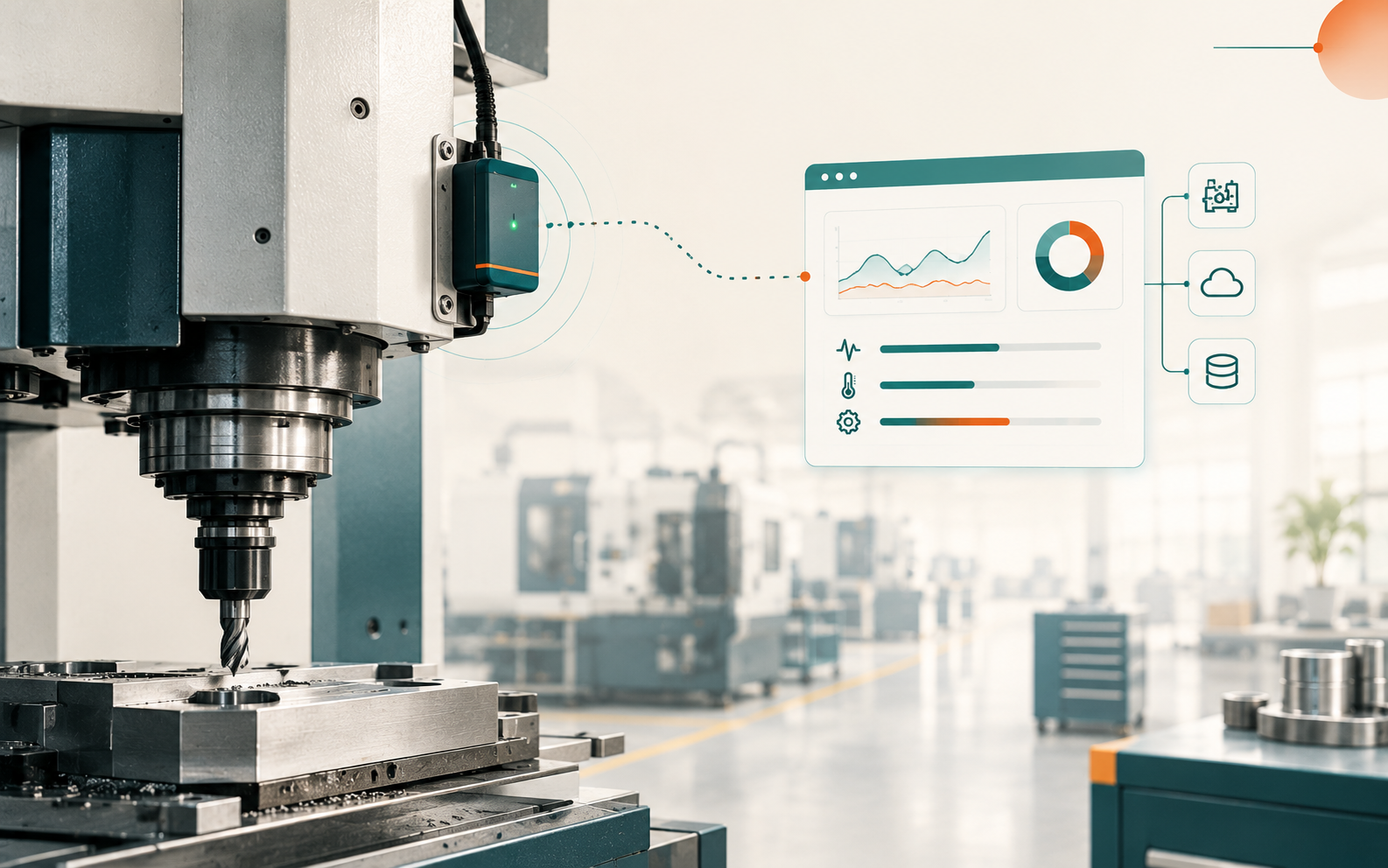
Industry 4.0 is the fourth industrial revolution, where machines, sensors and software share data across a plant so decisions get made from live numbers instead of yesterday's registers. India has real weight in this shift. MSMEs already produce 35.4% of India's manufacturing output and the auto component industry alone clocked a turnover of Rs 6.73 lakh crore in FY25, growing 9.6% over the previous year. The pressure to digitise is arriving from customers, not consultants.
Most plant owners reading this are not asking what the technology is. They are asking what it costs, what breaks, and whether it applies to a shop running 40 machines rather than 4,000.
- When your OEM asks how a batch was inspected 11 months ago, how long does the answer take, and who has to stop working to find it?
- If you were away from the plant this week, what would you actually know about output, rejection and downtime before Monday?
- When you last lost a bid, was it price, or was it that the buyer could not see how you control your process?
Those three questions are the real subject of this article. Adoption is uneven for a reason: Deloitte's 2025 smart manufacturing survey found respondents reporting up to 20% improvement in production output, yet McKinsey's research on Industry 4.0 has repeatedly found around 70% of pilots never reach full scale. We work on Indian shop floors every week, and below is what separates the two groups, written for a plant your size.
TL;DR
- Industry 4.0 is not one purchase. It is machine data, connected records and dashboards working as one loop.
- Old machines are not a blocker. Retrofit sensors and operator screens cover most Indian shop floors.
- The first project should pay back on a number your OEM already asks you about.
- Pilots die from ownership gaps, not technology gaps. Someone must read the dashboard daily.
- Audit-ready records are the fastest visible return for a tier-2 supplier.
- Score your plant before you budget. Readiness, not ambition, sets the starting point.
What Is Industry 4.0?
Industry 4.0 refers to manufacturing where physical machines are linked to digital networks, so the plant records, reads and acts on its own data as work happens. The phrase covers the technologies (sensors, connectivity, software) and the change in how a plant is run.
The older way is not wrong, it is just slow. An operator writes output on a log sheet, a supervisor totals it at shift end, and the number reaches the MD the next morning. Industry 4.0 removes that delay by letting the machine and the operator screen report directly.
Three things separate an Industry 4.0 plant from a computerised one:
- The data moves on its own. Nobody retypes a reading from paper into Excel before anyone can use it.
- The systems talk to each other. Production, quality and dispatch read from one record, not three separate files.
- The plant responds during the shift. A rejection spike raises a flag at 11 am, not in next month's review.
That third point is the one that matters commercially. A plant that reacts within the shift protects its delivery commitment, and a plant that reacts next month writes an apology letter instead. Where this started explains why it works this way.
From Steam to Sensors: How Industry 4.0 Differs From the Three Revolutions Before It
Each industrial revolution changed who or what does the deciding. Steam changed who supplies the power, electricity changed how work is divided, and electronics changed who does the repetitive task. Industry 4.0 changes who holds the information.
The pattern is easier to see side by side than to read in prose.
|
Revolution |
Roughly when |
The change |
What a plant owner gained |
|
First |
1784 onward |
Water and steam power mechanise production |
Output stopped depending on human muscle |
|
Second |
Late 1800s |
Electric power and the assembly line |
Mass production and division of labour |
|
Third |
1969 onward |
Electronics, PLCs and IT automate individual tasks |
Machines repeated a task without an operator |
|
Fourth |
2011 to present |
Cyber-physical systems, connected machines and data |
The plant reports its own condition, live |

|
“Velocity, scope, and systems impact.” Klaus Schwab, Founder and Executive Chairman, World Economic Forum His three reasons why this counts as a fourth revolution and not an extension of the third. The Forum's own Global Lighthouse Network now spans 238 recognised factory sites worldwide. Source: World Economic Forum, The Fourth Industrial Revolution |
The useful takeaway for a mid-sized plant is that the third revolution already happened on your floor. Your CNCs, PLCs and inverters are Industry 3.0 assets. Industry 4.0 mostly asks you to read what those assets already know.
The Key Technologies That Make Industry 4.0 Work on a Shop Floor
Every article on this keyword lists the same technologies. Fewer explain what each one physically becomes in a plant running mixed old and new machines, which is what decides whether you can afford it.
The four that AI Overviews name are the right starting four, and we have added two that Indian auto component suppliers hit almost immediately.
Industrial IoT
IoT means putting a reading where there was no reading. On an older VMC that is a retrofit sensor or a signal taken off the existing PLC, not a new machine. This is usually the cheapest step and the one that produces the first honest downtime number a plant has ever seen.
Artificial Intelligence and Machine Learning
AI on a shop floor is mostly pattern reading, such as flagging a spindle whose vibration signature is drifting before it fails. It needs history, so it is a year-two capability for most plants. Skipping straight to AI without clean data is the single most common way MSME budgets get wasted.
Cloud Computing
Cloud simply means the plant's data sits on a hosted server that the MD can open from anywhere, including from a customer's office. For plants with connectivity concerns or customer restrictions, an on-premise setup does the same job locally.
Advanced Robotics and Cobots
Robots handle repeat motion, loading, welding and palletising, and cobots work alongside operators without a cage. Payback depends on volume, so this ranks below data work for most tier-2 suppliers.
Digital Twin
A digital twin is a live software model of a machine, line or process that mirrors the real one. Most MSME plants meet this later, usually first as a simple line model for planning changeovers.
Cybersecurity and IT-OT Integration
Once machines are on a network, they inherit network risk. Role-based access, audit trails, and separating the machine network from the office network handle most of it.
Here is the part the enterprise articles skip. Read the technology list against your own floor before you read it against a brochure.
|
Technology |
What the brochure says |
What it becomes in a 40-machine Indian plant |
|
Industrial IoT |
Connected asset ecosystem |
Retrofit sensors on 8 to 12 of your slowest machines, plus operator tablets on the rest |
|
AI and ML |
Self-optimising production |
Rejection pattern alerts once you hold 9 to 12 months of clean data |
|
Cloud |
Elastic global infrastructure |
One hosted dashboard the MD opens on a phone from the OEM's office |
|
Robotics |
Autonomous manufacturing |
One or two cells, justified by volume, usually after the data layer works |
|
Digital twin |
Virtual replica of the enterprise |
A line model used to test changeover sequencing before you move machines |
|
Cybersecurity |
Zero-trust OT architecture |
Role-based logins, audit trails, and a machine network kept off the office LAN |
None of this requires replacing working machines, which is the assumption that stops most owners before they start. What it does require is deciding which numbers are worth having, and that is where benefits and problems both come from.
Is your quality data ready for an audit or scattered across notebooks?
Tell us what your plant records look like today. We'll show you what the digital version looks like mapped to your process, not a template.
Benefits and Challenges of Industry 4.0 for a Mid-Sized Plant
The split is fair on both sides: real gains on output, downtime and supply chain flexibility, set against cybersecurity risk, legacy hardware cost and skill gaps. Both halves are true, and the ratio between them depends almost entirely on sequencing.
The gains reported by manufacturers who scaled properly include:

|
“The smart manufacturing journey is still emerging, but its value is undeniable.” Tim Gaus, Smart Manufacturing Business Leader and Principal, Deloitte Consulting LLP In the same study, 78% of manufacturing leaders said they are putting more than 20% of their operational improvement budget into smart manufacturing, while only 29% had AI running at facility or network scale. |
The challenges are just as concrete. Legacy machines rarely speak a modern protocol, so retrofitting has a real cost. Operators who have written log sheets for 15 years need a screen that takes fewer taps than the paper took.
And the moment machines join a network, access control stops being optional. The plants that come out ahead treat these as sequencing problems rather than reasons to wait. What that sequencing looks like locally is worth seeing in detail.
What Industry 4.0 Looks Like Inside an Indian Auto Component Plant
Global examples are useful for direction and useless for planning, because a Lighthouse plant and a Chakan machining unit do not share a starting point. The Indian version of Industry 4.0 is quieter and starts with records.
It also has policy behind it. The Ministry of Heavy Industries runs SAMARTH Udyog Bharat 4.0, a demand-driven programme built specifically to bring Industry 4.0 within reach of Indian MSMEs. Four SAMARTH centres are operating, with 10 cluster experie nce centres approved under a hub-and-spoke model run through the C4i4 Lab in Pune, inside the belt most of our clients operate in.
Where it usually starts, in the order we see it work:
|
Why the audit angle is usually the trigger The IATF Rules 6th Edition took effect on 1 January 2025, tightening audit cycles, non-conformance timelines and supplier performance monitoring. A plant that can produce a batch's full history in a search rather than a search party is answering that pressure directly. |
|
“Our industry is making the necessary strides in investments, technology, and localisation.” Shradha Suri Marwah, President, Automotive Component Manufacturers Association of India That sector turned over Rs 6.73 lakh crore (USD 80.2 billion) in FY25 and grew at a 14% CAGR over five years, nearly doubling in size. |
When we build for auto component manufacturers, we map the existing route card and inspection format first, then build screens that match it. Operators adopt what looks like the job they already do. The question then becomes whether your plant is ready to start, and that can be scored.
The 10-Minute Industry 4.0 Readiness Score for MSME Plants
Most Industry 4.0 advice tells you where to go without telling you where you are. This grid fixes that. Score your plant honestly on six lines, 0 to 3 each, for a total out of 18.
|
# |
Ask this about your plant |
0 |
1 |
2 |
3 |
|
1 |
How does shift output get recorded? |
Paper only |
Paper, typed into Excel later |
Entered on a screen at shift end |
Entered live at the machine |
|
2 |
How do you know why a machine stopped? |
We ask the operator |
Written in a register |
Reason codes on a form |
Reason logged against the stoppage |
|
3 |
How long to retrieve one batch's full history? |
Days |
Hours |
Under an hour |
A search |
|
4 |
What does the MD see without calling the plant? |
Nothing |
A WhatsApp summary |
A daily report |
A live dashboard |
|
5 |
Do quality records link to dispatch documents? |
No |
Manually matched |
Partly linked |
Linked automatically |
|
6 |
Who owns the daily numbers review? |
Nobody |
Whoever is free |
A supervisor |
A named owner, fixed time |
Reading your score:
- 0 to 6, Paper-led. Start at records, not sensors. A digital log sheet will change more here than any AI project.
- 7 to 12, Partly digital. Your data exists but does not connect. Linking production and quality records is the highest-return next move.
- 13 to 18, Connected. You are ready for machine signals, predictive work and management dashboards that the whole leadership reads.

Almost every plant we assess scores lowest on line 6, and that single line predicts whether the project will survive. Which brings us to why so many of these projects quietly stop.
Why Most Industry 4.0 Projects Stall Before They Pay Back
The failure rate here is well documented and it is not a technology story. McKinsey's work on Industry 4.0 found that around 70% of pilots never reach scale, with roughly 74% of manufacturers still stuck at the pilot stage in its Lighthouse-era research.

The four reasons we see this happen on Indian shop floors:
The counter-move is unglamorous. Pick one number your customer already asks you about, make that number live and accurate, give one person responsibility for reading it every morning, and only then extend. That is also the difference between buying an off-the-shelf ERP and building around your process.
Plants that follow this order tend to fund the second phase out of the first phase's savings. Plants that start with the largest possible scope tend to have a very good presentation and a very quiet shop floor.
Is your quality data ready for an audit or scattered across notebooks?
Tell us what your plant records look like today. We'll show you what the digital version looks like mapped to your process, not a template.
Why Should You Choose Edhaas Digisoft for Your Industry 4.0 Move?
Industry 4.0 fails for MSMEs when the software expects the plant to change first. We work the other way around, mapping your route card, inspection format and dispatch flow before a single screen is designed.
How we work:
- Process-first builds shaped around your existing shop floor, never a template.
- Barcode, QR and machine data linked into one record.
- Modular rollout sized to an MSME budget, phase by phase.
What that has produced:
- Production cycle time improved by 40% on a digital log sheet build.
- A disputed batch verified in minutes instead of days, confirming scrapped items and protecting the client's standing with their customer.
- Zero missing records at audit, with documentation ready to hand over.
We are Pune-based and founder-led, working across Chakan, Pimpri-Chinchwad and Ranjangaon, which means issues get answered by the people who built the system.
Ready to see what your first phase would actually cost? Schedule a Consultation.
Conclusion
Industry 4.0 is not a purchase decision, it is a sequence. For an Indian auto component plant the return shows up first in things your customers already measure you on: how fast you answer a batch query, how accurately you hold a delivery date, and how much idle time you can prove you removed. Those are the numbers that survive an OEM vendor review.
The starting point is smaller than the term suggests. Score your plant on the six lines above, pick the one number your customer asks about most, and make that number live before you buy anything else. Plants that begin there fund their next phase from their first. Plants that begin with the technology catalogue usually begin twice.

Questions