
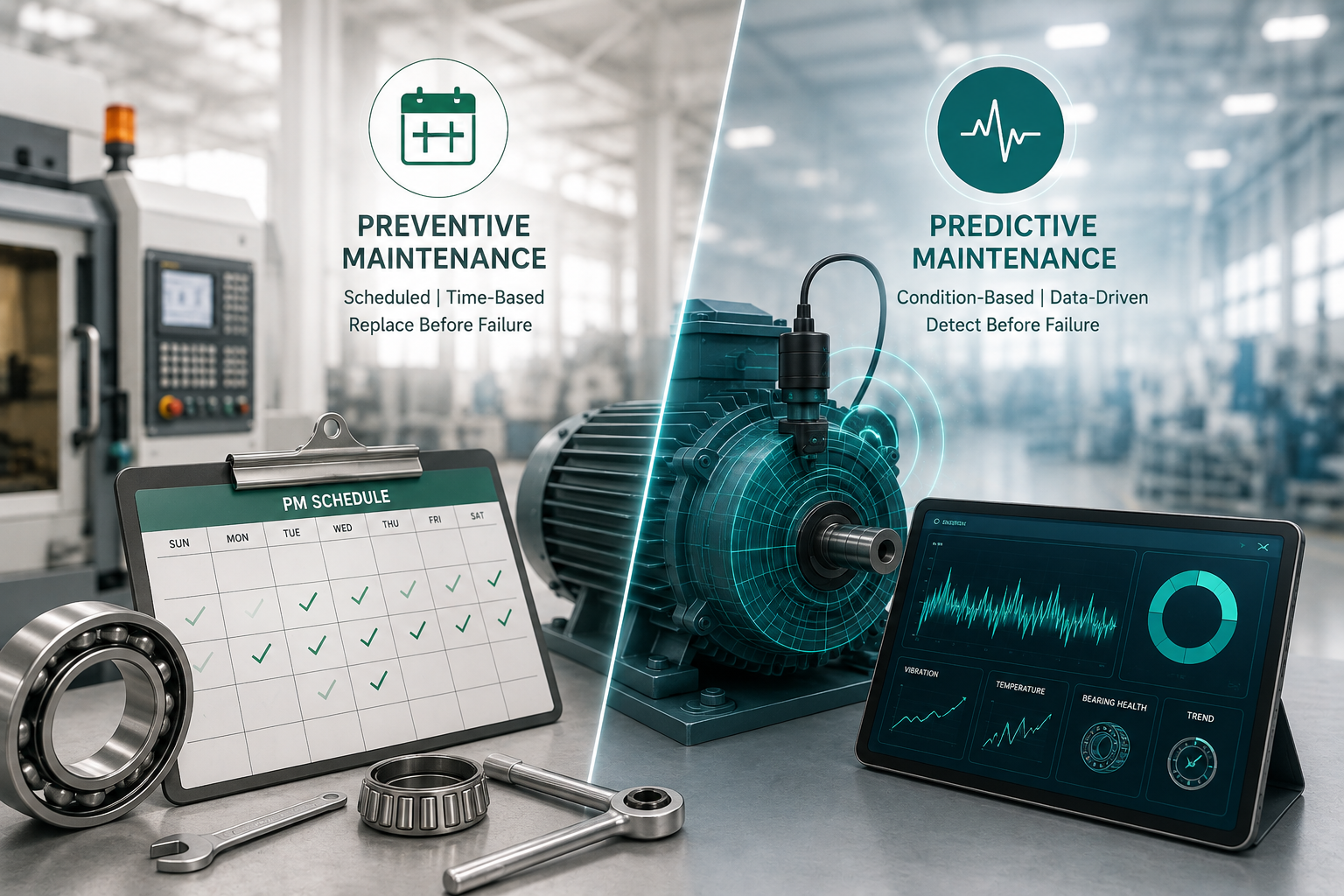
Preventive maintenance runs on a fixed calendar or a meter count. Predictive maintenance runs on what the machine is telling you right now. Both are proactive, and the money sits in the gap between them.
That gap is not small. Deloitte Insights reports that poor maintenance strategies can reduce a plant's overall productive capacity by 5 to 20 percent, and that unplanned downtime costs industrial manufacturers an estimated $50 billion a year. The US Department of Energy's O&M Best Practices work puts a number on the first step: moving off reactive-only maintenance saves 12 to 18 percent on average, and a working predictive programme adds another 8 to 12 percent on top of preventive alone.
Before you price a single sensor, sit with these three questions:
- Your last spindle failure had a completed PM job card behind it. So what exactly did the schedule miss?
- If an OEM auditor asked for the maintenance history of one specific machine for the last six months, how many minutes would that take to produce?
- You know which machine breaks most often. Do you know which machine costs you the most per hour when it breaks?
Those three questions separate a plant that is ready for predictive maintenance from a plant that is about to waste money on it. This article works through the real differences between preventive vs predictive maintenance, then gives you a scoring grid to sort your own asset list, and finally sets out the order these things have to happen in. That order is where most MSME plants get it wrong.
TL;DR
- Preventive is triggered by time or usage. Predictive is triggered by machine condition.
- Preventive costs little to start and wastes component life. Predictive costs more upfront and wastes almost none.
- Age-based schedules only help a minority of your assets. Most failures do not follow a calendar.
- The right answer is per machine, not per plant. Score each asset on stoppage cost and warning time.
- Predictive cannot be bought off a shelf. It needs your own failure history in a readable form first.
- Plants that digitise maintenance records first get a working predictive case in months, not years.

What Is Preventive Maintenance?
Preventive maintenance is servicing done on a fixed schedule, before anything has gone wrong. The trigger is a date on a calendar or a reading on a meter, such as every 500 running hours.
It assumes wear builds up predictably with use. Change the oil at the interval, replace the belt at the interval, and the failure never arrives. Most Indian auto component plants already run some version of this, usually on a register or an Excel sheet.
Typical preventive jobs on a machining or pressing floor look like this:
- Gearbox oil changes and greasing on a set hour count
- Filter and belt replacement on presses and compressors at fixed intervals
- Quarterly calibration of gauges, fixtures and measuring instruments
- Annual electrical safety and earthing checks on panels and EOT cranes
The strength of preventive maintenance is that it needs no new hardware. The weakness is that it treats every machine as though it ages on a schedule. That assumption holds for some equipment and quietly fails for the rest, which is what the next section is about. If you want the mechanics of running these schedules digitally, our guide to preventive maintenance software for manufacturing covers the job card side in detail.
What Is Predictive Maintenance?
Predictive maintenance watches the actual condition of a machine and calls for work only when a failure is genuinely approaching. Nothing is replaced on a date. Things are replaced on evidence.
The evidence comes from readings taken while the machine runs. Vibration on a spindle, temperature on a bearing, current draw on a motor, particle count in hydraulic oil.
The key steps involved are:
Step 5 is the one everybody skips, and it is the one that decides whether predictive maintenance works in year two. Without a clean record of what failed and when, the model never gets better than the day it was installed.
Is your quality data ready for an audit or scattered across notebooks?
Tell us what your plant records look like today. We'll show you what the digital version looks like mapped to your process, not a template.
Preventive vs Predictive Maintenance: The Four Differences That Decide Your Budget
The AI Overview for this keyword sorts the comparison on four points, and they are the right four. Below they are laid out with the two rows the summaries leave out, skill requirement and audit evidence, because both cost real money in an IATF-certified plant.
|
Preventive Maintenance |
Predictive Maintenance |
|
|
Trigger |
Calendar date or meter count, for example every 500 hours |
Live condition data such as vibration, heat or current |
|
Upfront cost |
Low. Uses people and process you already have |
High. Sensors, gateways, storage and analytics |
|
Waste |
Replaces parts that still had usable life left |
Uses close to the full life of each component |
|
Best used for |
Standard, lower-impact assets with predictable wear |
High-value machines where a sudden stop is expensive |
|
Skill needed |
Existing maintenance team with clear job cards |
Someone who can read and act on condition data |
|
Audit evidence |
Completed schedules and PM compliance records |
Condition trends plus the action taken on each alert |
Read that table one column at a time and a pattern appears. Preventive buys certainty cheaply and pays for it in wasted parts. Predictive buys precision expensively and pays for it in setup and skill.
Neither is better in the abstract. The question is which one each machine on your floor deserves, and the answer depends on something most comparison articles never mention.
The Failure Pattern Most PM Calendars Ignore
Here is the finding that changes how you should read every schedule in your maintenance register. Equipment failure mostly does not follow age.
|
Only 18 percent of assets have an age-related failure pattern; 82 percent exhibit a random pattern. Hiroshi Yokoi, Yokogawa Electric Corporation, citing ARC Advisory Group research in Asset Management Transformed, ISA InTech, April 2021. The same article notes unplanned downtime costs the process industries about $1 trillion a year in lost production and revenue. |

Sit with what that means for a plant running purely on intervals. A time-based schedule is built on the assumption that failure probability climbs with use, and for most assets that assumption does not hold.
This is why a completed PM job card and a seized spindle can appear in the same fortnight. The schedule was followed correctly. The failure simply was not the kind that a schedule can see.
It does not make preventive maintenance useless. It makes blanket preventive maintenance wasteful, because you are paying interval costs on assets that were never going to fail on an interval. The fix is to sort your assets rather than treat them alike, which is exactly what the next section does.
How to Choose Between Preventive and Predictive Maintenance, Machine by Machine
Every competing article on this keyword ends at a hybrid approach and leaves you there. The useful version is a score you can run against your own asset register this week.
Rate each machine from 1 to 5 on two axes. Stoppage cost is what one hour of that machine being down actually costs you in lost output, idle labour and late dispatch penalties. Warning time is how much notice a failure gives you through vibration, noise, heat or current before it stops the machine.
|
Stoppage cost |
Warning time |
Strategy that fits |
Typical assets in an auto component shop |
|
High (4 to 5) |
Long (4 to 5) |
Predictive. Sensors pay back fastest here |
CNC and VMC spindles, induction furnaces, main compressors |
|
High (4 to 5) |
Short (1 to 2) |
Preventive, tightened. Shorter intervals, spares on shelf |
Hydraulic press seals, tool holders, high-value fixtures |
|
Low (1 to 2) |
Long (4 to 5) |
Basic condition checks. Operator rounds, no sensors |
Coolant pumps, exhaust fans, secondary conveyors |
|
Low (1 to 2) |
Short (1 to 2) |
Run to failure. Schedules here are pure cost |
Light fittings, hand tools, non-process fans |

How to run the exercise:
Most plants find the same thing on step 4. They are running identical monthly schedules on machines sitting in four different boxes. Correcting that costs nothing and frees the budget that predictive maintenance will later need. A management dashboard makes the imbalance visible in a way a register never will.
The Hybrid Approach, and the Order It Has to Happen In
Every source agrees the answer is hybrid. What none of them say is that hybrid has a sequence, and skipping a rung is why sensor projects stall at pilot stage in MSME plants.
|
On average, predictive maintenance increases productivity by 25%, reduces breakdowns by 70% and lowers maintenance costs by 25%. Deloitte Analytics Institute, Predictive Maintenance position paper. |

Those numbers are real, and they are earned by plants that arrived with a failure history. Here is the ladder that gets you there.
|
The Data Readiness Ladder Rung 1. Make the asset register real. Every machine, its criticality score, its spares and its owner, in one place instead of four notebooks. Rung 2. Move job cards off paper. The technician records what was actually done, on the machine, at the time. Rung 3. Record failures with causes, not just dates. Bearing replaced is a line item. Bearing replaced, abnormal noise reported two shifts earlier is training data. Rung 4. Add sensors only to the top-right box. By now you know which machines those are, and you have months of history to check the sensor against. |
Rung 3 is the one that decides everything. You cannot buy predictive maintenance as a product, because the thing that makes it work is your own failure history, and no vendor has that. A plant that has been recording causes for a year can justify sensors on three machines with evidence. A plant on paper registers is guessing, and guessing at sensor budgets is how MSMEs end up with an expensive dashboard nobody opens. A CMMS-style system does rungs 1 to 3 without changing how the team works.
This is also where the audit case sits. IATF 16949 clause 8.5.1.5 asks for documented maintenance objectives and for predictive methods where applicable, and where applicable is a judgement you can only defend with records. Getting rungs 1 to 3 right serves the auditor and the sensor business case at the same time. Our work on production tracking follows the same logic on the output side.
Is your quality data ready for an audit or scattered across notebooks?
Tell us what your plant records look like today. We'll show you what the digital version looks like mapped to your process, not a template.
Why Should You Choose Edhaas Digisoft for Preventive and Predictive Maintenance?
Most maintenance products ask your plant to change its process to match their screens. We map how your shift actually runs first, then build to it. That matters most for auto component manufacturers whose job cards, breakdown slips and shift handovers already carry twenty years of local logic.
What we build
Preventive maintenance systems shaped to your existing schedules, not a template. Breakdown and cause recording that turns into a failure history worth analysing. Barcode and QR scanning with machine and IoT data feeds when you reach rung 4.
What plants see after go-live
- Machine history retrieved in seconds during an OEM or IATF audit, instead of a file hunt
- PM compliance, MTBF and MTTR visible to the MD without a phone call to the plant
- Sensor spend justified with your own numbers before the first purchase order
We are founder-led and hands-on, working across Pune, Chakan, Ranjangaon and Pimpri-Chinchwad, with modular rollouts sized for MSME budgets. You can see the approach in our production dashboard case study.
|
Want to know which of your machines actually justify sensors? |
|
FY25 was yet another milestone year where the industry's growth was underpinned by strong domestic demand, rising exports, and increasing value addition. Shradha Suri Marwah, ACMA President and CMD, Subros. The industry closed FY25 at Rs 6.73 lakh crore, growing 9.6% year on year, per ACMA's FY25 performance release. |
Conclusion
Preventive vs predictive maintenance is not a choice you make once for the whole plant. It is a call you make per machine, using stoppage cost and warning time, and most plants find their current schedule is wrong in both directions at once. Some machines are being serviced too often for what they cost you, and the ones that genuinely need watching are being watched by nobody.
The business case follows the same order. Sort the asset list, get maintenance records off paper, record causes rather than dates, and only then price sensors for the handful of machines that earn them. Do it in that sequence and the predictive investment defends itself with your own data. Do it backwards and you buy hardware that nobody trusts.

Questions