India's auto component sector turned over ₹ 7,59,234 crore in FY2025-26, with supplies to OEMs growing 16.3% to ₹ 6,62,893 crore, according to ACMA. More volume means more dispatches, and every dispatch carries a document set. Most suppliers scaled the production side and left the paperwork on Excel.

The cost shows up in cash. Delayed payments to MSMEs stood at ₹ 7.34 lakh crore as of March 2024, over 4.6% of India's gross value added, per the GAME-FISME Delayed Payments Report 3.0. Alongside that, GST e-invoicing is mandatory above ₹ 5 crore turnover, and firms above ₹ 10 crore must report invoices to the IRP within 30 days.

- Can you produce the inspection record for a batch you dispatched three weeks ago, without opening a file cabinet?
- When an OEM holds your invoice over a document mismatch, how many days pass before anyone in your plant hears about it?
- If a customer disputes a batch tomorrow, can your invoice prove what was checked, and when?
Most automotive invoice software answers none of these. It was built for garages billing walk-in repairs, not for suppliers whose invoice has to survive an OEM's incoming quality desk. This article covers what the supplier side actually needs, and why the document, not the part, is usually what holds up your money.
TL;DR
- Your invoice clears faster when it points to the inspection record, not when it is raised sooner.
- Garage billing tools handle job cards and counter sales, and stop short of dispatch clearance.
- A rejected document set restarts the statutory payment window, so paperwork errors cost cash, not just time.
- Batch identity carried onto the invoice turns a customer dispute into a lookup instead of a file hunt.
- Record retention for automotive audits is a design decision, not something you fix later.
What Is Automotive Invoice Software?
Automotive invoice software is a system that creates, validates and stores invoices for automotive businesses. For a supplier it also links each invoice to the production and quality records behind the goods being billed.
That link is the whole difference. At Edhaas Digisoft we build these systems so the invoice pulls its data from the shop floor rather than from a typist re-entering figures.
For an auto-component supplier, a working system usually holds three things together:
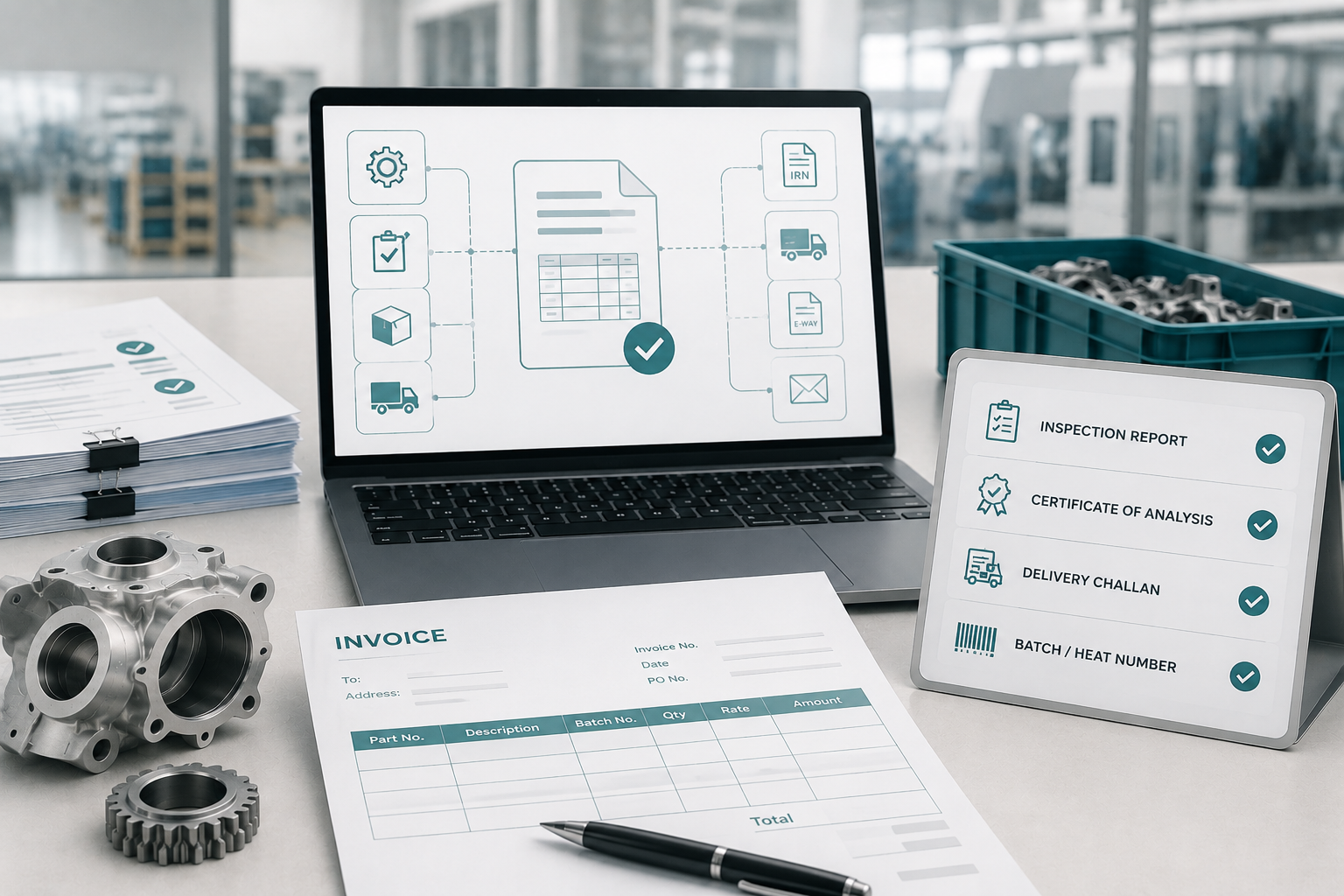
- Commercial data: part number, quantity, rate, GST treatment, purchase order and schedule reference.
- Quality data: inspection status, batch or heat number, and the Certificate of Analysis for that lot.
- Logistics data: delivery challan, e-way bill, and the advance shipping notice the OEM expects.
Keep those three in separate places and someone reconciles them by hand every dispatch. Keep them in one place and the invoice writes itself. The next section shows why the popular tools only cover the first of the three.
Why Garage Billing Software Fails an Auto Component Supplier
Most tools ranking for automotive invoice software were designed for workshops and spare parts counters. They do that job well. They were never asked to clear a batch through an OEM's documentation check.
The gap is not about features. It is about what the invoice has to prove.
|
What the invoice must do |
Garage or retail billing tool |
Auto component supplier need |
|
Bill the customer |
Yes, GST invoice in seconds |
Yes, against OEM schedule and PO |
|
Identify the goods |
Item name and rate |
Part number, batch, heat or lot number |
|
Prove inspection |
Not covered |
Inspection report and CoA linked to the lot |
|
Match dispatch papers |
Manual |
Challan, e-way bill and ASN generated together |
|
Handle rejection |
Credit note |
Debit note against a traceable batch |
|
Survive an audit |
Sales register |
Retained records tied to each shipment |
Read the right-hand column and you are looking at a quality system, not a billing app. That is why suppliers who buy a counter-billing tool end up running a parallel Excel sheet within a quarter. The next section lists what actually has to sit on that document.
What Belongs on an Auto Component Supplier's Invoice
An OEM's incoming desk checks the paperwork before it checks the parts. When one field does not agree with another, the whole set goes back.
The items below are what suppliers are most often asked to correct. Treat this as the checklist your automotive invoice software should satisfy on its own.
Seven fields, and five of them live outside the accounts department. That is the reason manual invoicing takes a full day at month-end, and the reason we build the link from the shop floor upward rather than the ledger downward.
Is your quality data ready for an audit or scattered across notebooks?
Tell us what your plant records look like today. We'll show you what the digital version looks like mapped to your process, not a template.
How Automotive Invoice Software Works at the Dispatch Gate
The point of the system is not faster typing. It is that dispatch cannot clear until the record is complete.
Here is how the sequence runs in a plant where the invoice is tied to production. The key steps involved are:
Step 1: Production books the lot
The operator records output against a job or batch on the shop floor. That batch number now exists in the system, not on a log sheet.
Step 2: Inspection records the result
Final inspection enters readings against the same batch. Pass, rework or scrap is recorded with the inspector's electronic approval.
Step 3: Dispatch requests clearance
Stores raises a dispatch request. The system checks whether that batch has a passed inspection against it.
Step 4: The gate holds or opens
No inspection record means no clearance. This is the control most suppliers do not have, and it is where escapes get stopped.
Step 5: Documents generate together
Invoice, challan, e-way bill and CoA are produced from one data set, so the references agree by construction.
Step 6: The IRN is filed
The invoice goes to the GST portal and returns with its IRN and QR code inside the reporting window.
Six steps, and only two of them happen in an office. Getting this right is ordinary engineering work, and it is what our production management and quality management systems are built to do together.
GST E-Invoicing and the 45-Day Payment Clock
Two rules govern when your money arrives, and most suppliers only track one of them. Missing either turns a completed job into an ageing receivable.
The first is the GST reporting window. The second is the statutory payment period for micro and small suppliers under the MSMED Act.
The IRN window is not a formality
An invoice reported late is rejected by the portal, and no IRN is issued. At that point the document is not a valid tax invoice, and your customer cannot take credit against it.
The 45-day clock restarts on rejection
Buyers must settle micro and small enterprise dues within 45 days of acceptance. Acceptance is the operative word, because a document set sent back for correction has not been accepted.
|
"Digital readiness is increasingly a prerequisite for global OEM sourcing due to rising expectations on traceability, audit readiness and zero-defect quality." Vikrampati Singhania, President, ACMA. The ACMA and BCG joint study found over two-thirds of surveyed companies are already piloting, scaling or running smart factory systems, and that firms with scaled deployment are more than twice as likely to report strong business impact. |

So a document error is not an administrative annoyance. It is a cash event that pushes payment into the next cycle, and it repeats every time the same mismatch occurs. What that looks like when it is fixed is covered next.
What Changes on the Shop Floor
This is not theory for us. One of our clients ran final inspection on manual reports with physical signatures, and cleared dispatch on paper.
Then a customer reported a defective item from a batch that quality had already passed. Verification meant retrieving records by hand while the customer waited.
|
What we implemented: digital inspection reports with electronic approvals. Inspection data linked automatically to invoices and dispatch documents. A digital Certificate of Analysis issued with every batch. |
This resulted in:
- Dispute handling: the disputed batch was verified in minutes, confirming the items had been scrapped, which protected the client's credibility with their customer.
- Record integrity: zero missing records, with documentation ready for audit.
- Customer confidence: the supplier could answer with evidence instead of assurances.
The part that mattered was not the software. It was that the answer existed before the question was asked. You can read the related work on our traceability case study, and the same thinking sits behind how we approach auto component manufacturers generally.
How to Choose Automotive Invoice Software for a Component Plant
Buying by feature list is how suppliers end up with a second Excel sheet. Ask instead what the system refuses to let you do.
Does it block a dispatch without an inspection record?
If clearance is advisory rather than enforced, the control does not exist. A warning message is not a gate.
Does it fit your existing document flow?
Your OEM's format expectations are fixed and yours are already set. Software that asks you to change your process to match its screens will be worked around.
Can it retain records for the period your audits require?
Automotive record retention runs for years, and retrieval speed is what gets tested during a surveillance audit.
Will it talk to what you already run?
Most plants have Tally or an ERP in accounts. The invoice data has to reach it without a re-entry step.
Answer those four honestly and the shortlist gets very short. We map the workflow first and build to it, which is why our systems tend to sit inside the process rather than beside it.
Is your quality data ready for an audit or scattered across notebooks?
Tell us what your plant records look like today. We'll show you what the digital version looks like mapped to your process, not a template.
Why Should You Choose Edhaas Digisoft for Automotive Invoice Software?
Auto component suppliers need invoices that hold up at the customer's incoming desk. Your current setup may bill correctly and still fail the documentation check. Edhaas Digisoft changes what your invoice can prove.
Solutions That Matter:
Custom-built systems shaped around your existing dispatch process, never a template. Barcode and QR scanning with machine and IoT data integration. Tally and ERP integration so accounts get the data once.
Proven Performance on the Shop Floor:
- Dispute handling: "Verified a disputed batch in minutes, confirming scrapped items."
- Record integrity: "Zero missing records with audit-ready documentation."
- Retrieval speed: "Seconds to trace any batch, instead of hours of paperwork."
Your invoice needs systems built around your rules. We map your workflow first, then build the software to fit it. Founder-led, hands-on, and based in Pune with teams working across Chakan and Ranjangaon.
Ready to change what your invoice can prove? Schedule a Consultation!
Conclusion
The invoice is the last thing your plant produces and the first thing your customer inspects. When it carries the batch identity and the inspection record with it, the document clears on the first pass and the payment cycle starts when you expect it to. When it does not, your team spends the month reconciling paperwork that production already got right.
Automotive invoice software is worth buying only if it closes that gap. For an auto-component supplier that means enforcement at the dispatch gate, documents generated from one data set, and records that come back in seconds during an audit. That is the difference between billing faster and getting paid sooner.
Questions